How the Brain Learns from BCI Training
Why do some people excel at controlling a BCI while others struggle? Part of the answer lies in how the brain adapts during training. I study the neurophysiological changes that unfold as users learn to modulate their own brain activity through BCI and neurofeedback, with the goal of making these systems more effective and personalized.

Last updated on
Apr 17, 2026
Marie-Constance Corsi
Research scientist
My research interests include bridging the gap between biomedical engineering and neurosciences to propose new tools to improve closed-loop systems.
Publications
Neurophysiological screening of individual variability for robust decoding in c-VEP-based BCI
Code-modulated visual evoked-potential (c-VEP) based reactive brain-computer interfaces (BCIs) deliver high information-transfer rates …
Sébastien Velut, Jordy Thielen, Sylvain Chevallier, Marie-Constance Corsi, Frédéric Dehais
Neural mechanisms of training in Brain-Computer Interface: A Biophysical modeling approach
Brain-computer interface (BCI) is a system that translates neural activity into commands, allowing direct communication between the …
Apurba Debnath, Tristan Venot, Marie-Constance Corsi, Parul Verma
Neuronal avalanches as a predictive biomarker of BCI performance: towards a tool to guide tailored training program
Brain-Computer Interfaces (BCIs) based on motor imagery (MI) hold promise for restoring control in individuals with motor impairments. …
Camilla Mannino, Pierpaolo Sorrentino, Mario Chavez, Marie-Costance Corsi
BCI learning induces core-periphery reorganization in M/EEG multiplex brain networks
Brain-computer interfaces (BCIs) constitute a promising tool for communication and control. However, mastering non-invasive closed-loop …
Marie-Constance Corsi, Mario Chavez, Denis Schwartz, Nathalie George, Laurent Hugueville, Ari E. Kahn, Sophie Dupont, Danielle S. Bassett, Fabrizio De Vico Fallani
Phase/Amplitude Synchronization of Brain Signals During Motor Imagery BCI Tasks
In the last decade, functional connectivity (FC) has been increasingly adopted based on its ability to capture statistical dependencies …
Tiziana Cattai, Stefania Colonnese, Marie-Constance Corsi, Danielle S. Bassett, Gaetano Scarano, Fabrizio De Vico Fallani
Functional disconnection of associative cortical areas predicts performance during BCI training
Brain-computer interfaces (BCIs) have been largely developed to allow communication, control, and neurofeedback in human beings. …
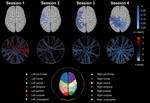
Marie-Constance Corsi, Mario Chavez, Denis Schwartz, Nathalie George, Laurent Hugueville, Ari E. Kahn, Sophie Dupont, Danielle S. Bassett, Fabrizio De Vico Fallani
Learning in brain-computer interface control evidenced by joint decomposition of brain and behavior
Motor imagery-based brain-computer interfaces (BCIs) use an individual’s ability to volitionally modulate localized brain activity as a …
Jennifer Stiso, Marie-Constance Corsi, Jean M. Vettel, Javier Omar Garcia, Fabio Pasqualetti, Fabrizio de Vico-Fallani, Timothy Lucas, Danielle S. Bassett
Characterization of Mental States through Node Connectivity between Brain Signals
Discriminating mental states from brain signals is crucial for many applications in cognitive and clinical neuroscience. Most of the …
Tiziana Cattai, Stefania Colonnese, Marie-Constance Corsi, Danielle S. Bassett, Gaetano Scarano, Fabrizio De Vico Fallani

