Abstract
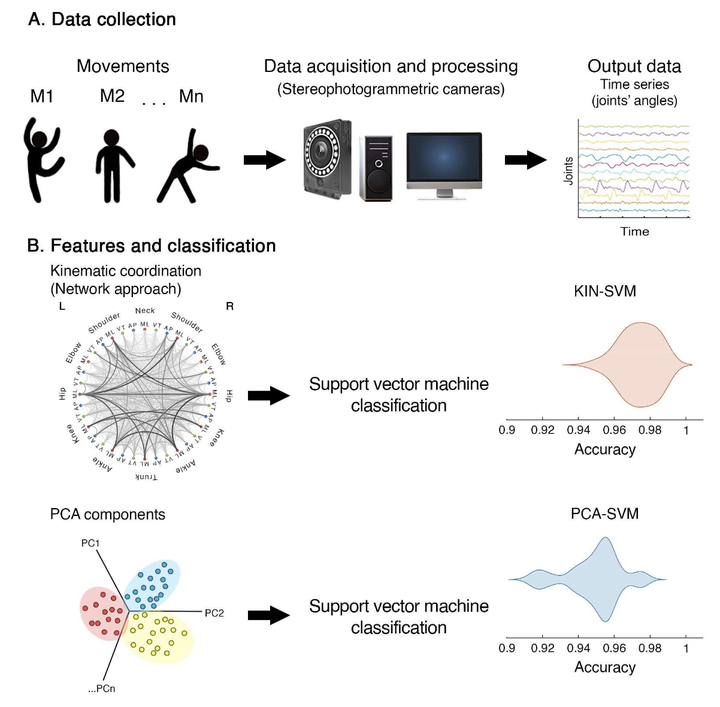
Automatic movement recognition is often used to support various fields such as clinical, sports, and security. To date, there is a lack of a classification feature that is both interpretable and not movement-specific. Previous studies on motion analysis have shown that coordination properties extracted using network theory can describe specific movement characteristics, making coordination a potential feature for classification. Hence, we leveraged kinematic data from 168 individuals performing 30 different movements, published in an online dataset and compared features extracted using network theory (kinectomes) to the ones extracted using principal component analysis (PCA). The classification accuracy of the kinectome (0.99 ± 0.01) was significantly higher (p textless 0.001) than that of PCA (0.96 ± 0.04), but not significantly different from UMAP (0.98 ± 0.02, p = 0.314). Our results show that both kinectome- and UMAP-based features achieve high classification accuracy. However, kinectomes provide the key advantage of interpretability, enabling anatomically and functionally meaningful insights into movement patterns.